“Thus organisms and environments are both causes and effects

in a coevolutionary process.”

—Richard C. Lewontin in The Triple Helix: Gene, Organism, and Environment.

Sunday, February 16, 2014

Año Nuevo State Park

As part of my Seymour Center docent training, I went with the other volunteers to Año Nuevo State Park to experience the rookery of elephant seals.

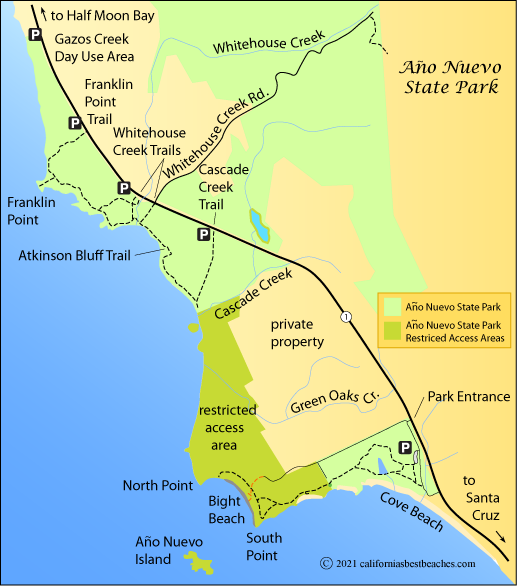
Map of Año Nuevo from californiasbestbeaches.com

A sign near the visitor's center.


View from a trail.

Año Nuevo State Park is close to Santa Cruz, only about 30 miles north on Hwy 1. Normally, visitors must schedule a guided tour of the rookery if they want to see the seals, because the seals don't care much about visitor safety. They are on the beach once a year to give birth and breed from about December to March (excluding March). During this time, they don't eat or drink, and the males try to gain control of a harem of females in which to obtain mates. This system is actually beneficial for the females, because the dominant male defends her from other males that may harass her.

My favorite facts I learned while at the park were about weight: when mothers feed their pups milk for a few weeks, the moms lose about 200 lbs and the pups gain about 200 lbs! Then the moms leave for the rest of the year to eat back their weight, and the pups stay on the beach for two months while their bodies process all the fat they just gained until they are ready to swim.


We learned a lot about the research being done through UCSC under scientist Dr. Colleen Reichmuth and colleagues. They are trying to understand how the seals communicate vocally, and were on the beach with us recording seal sounds. I can't share the pictures I took of the seals unless it is education-related, so if you learned something from the above paragraphs, email me and I can send you a cool picture or two that you should not share publicly.


*Update: I have since helped Dr. Dan Costa's lab members weigh the weaned pups on the beach. Their research is focused on the life history and feeding ecology of the seals. There were hundreds of them at the beach, looking like sacs of blubber and making cute, guttural screaming noises. Some of them were farther up in the shrubs chewing on leaves. When we would walk by to check their flippers, they would throw their heads back to let out a baby scream and reveal bright green foliage inside their hot pink-colored mouths. We weighed, tagged, and measured them from 7 to 10 am.

Saturday, January 25, 2014

A Catholic Evolutionary Ecologist

Before I begin, a few basics:
1. I am a practicing Catholic
2. I am studying for a PhD in Ecology and Evolution
3. This post reflects only my own personal opinions and ideas

Due to these two facts, I have been confronted at least once (and this one time I am thinking of was a very serious and prolonged encounter) about how I can reconcile being Catholic, i.e. believing in intelligent design, and believing in evolution. When this encounter happened, I didn't know how to respond because it never occurred to me that these ideas must conflict and that this should elicit a prolonged discussion.

There are innumerable ideas regarding the relationship between intelligent design and the origin of life on Earth. I would like to write a detailed report on this topic, but I don't have time for that. Instead, I would like to report my opinion.

My Feelings on the Interaction between the Ideas of Intelligent Design and Evolution
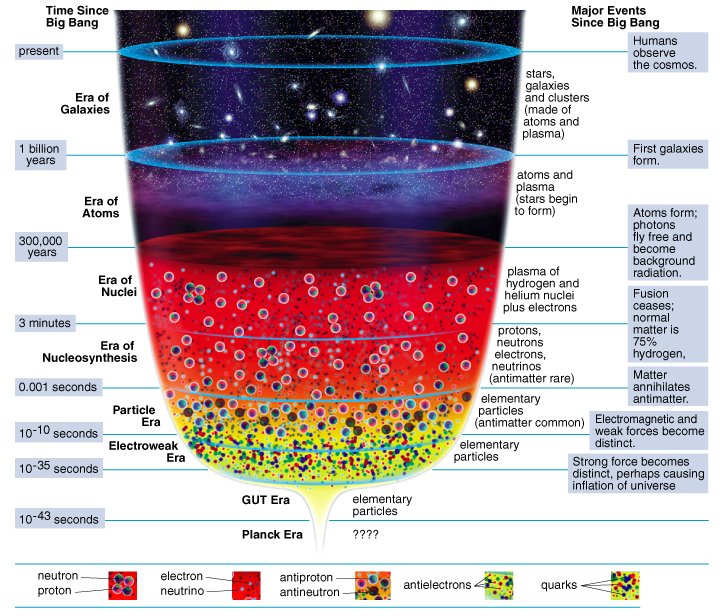
The popularized idea of intelligent design is that one day there were no biological organisms, and then the next day* God created them all. The popularized idea of evolution is that one day* there was no Earth and the next day BANG!, there it was, and billions of years later, atoms eventually arranged themselves in multicellular organisms.

Image from http://www.angelfire.com/mi/dinosaurs/genesis.html


Image from http://news.softpedia.com/newsImage/Nuclear-Chemistry-of-the-Big-Bang-2.jpg/

The problem with these popular ideas is that they appear to be mutually exclusive. This is a similar problem to one in the medieval times when astronomy was being well-studied in Catholic institutions in order to learn more about God and Heaven. People were seeking theological knowledge through science to support their belief that Earth was the center of the universe. However, in this process they found evidence that Earth revolved around the Sun. Since this was contrary to the theology at the time, and the idea was largely rejected.

Hundreds of years later, this fact is common knowledge and not a single well-respected theologian contests it. Somehow, despite biblical verses that suggest otherwise, Christians accepted an alternate explanation of the universe. In fact, Pope John Paul II apologized for the lifetime house arrest imposed on Galileo in 1655 for disseminating his at the time outrageous astronomical research.

Is it because the astronomical facts were logical and clear, and simply couldn't be denied? Is it because this fact did not fundamentally challenge Christian beliefs, but more of a traditional way of thinking?

Image from http://www.projectbritain.com/calendar/May/beagle.html

This story parallels that of the origin of evolutionary biology. Charles Darwin, an aspiring pastor, was interested in God's creation and set off on a boat to study it scientifically. This pursuit led him to observe changes in the beaks of birds over time, which led to his theory of natural selection. (Lucky for Darwin, he wasn't condemned to house arrest as a result of his research.) I don't believe he went so far as to suggest that all life on Earth began this way from a single cell, and as my Evolutionary Ecology professor put it in class today, his work On the Origin of Species perhaps would have better been named On the Origin of Local Adaptation because local adaptation is what Darwin was witnessing, not complete speciation. However, as more ecologists and geneticists studied how organisms change, such a theory of the origin of life became inevitable.

Currently, at least in the United States, this theory is contested by those that believe literally in the Biblical creation story. Does resistance to this evolutionary idea reflect a challenge to a fundamental Christian truth or a traditional way of thinking? If this resistance prevents further understanding about God's creation, is it worth it?

Just as modern astronomy can coexist with the Christian belief system, so can modern ecology and evolution. Christianity can continue to be a wonderful and enriching way of living even if humans evolved from primates. (For the record, modern Catholicism, which is quite liberal if you ask me, does not deny that humans evolved from primates.) I think both the popularized ideas of intelligent design and modern ecology can be taken too literally. Intelligent design doesn't have to exclude the process of evolution, and evolution doesn't have to be so random; I would argue that intelligent design has to include evolution, and evolution can't be totally random.

Perhaps in a hundred years or so, no well-respected theologian will deny the evolution of life from a single cell. Or perhaps scientists will find evidence for another theory of the origin of life. Either way, there is no reason why our observations about the world should contradict religious beliefs or vice versa.

If you ask me, the apparent conflict between Christianity and Evolution is a an excellent way to miss a lot of really important things in life.

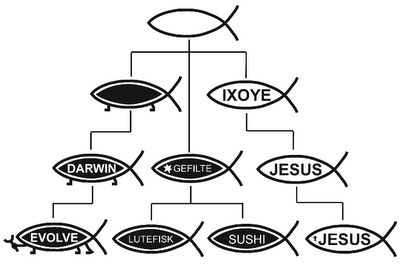
Image from http://friendlyatheist.tumblr.com/post/7191084362/a-post-about-the-evolution-of-fish


Notes.
*The word "day" is not used to imply a 24-hour period, since before Earth and the Sun were created there were no 24-hour days as we now know them. It is used as an nondescript measure of time.


Wednesday, January 1, 2014

The Sound of Doom

In Douglas Adam's book Life, the Universe, and Everything, part of his Hitchhiker's Guide to the Galaxy (HGG) series, the sound of one hundred thousand people saying "wop" is a very important and ominous onomatopoeia*:

What happened next they could not ignore. With a noise like a hundred thousand people saying "wop", a steely white spaceship suddenly seemed to create itself out of nothing in the air directly above the cricket pitch and hung there with infinite menace and a slight hum.

Such is the sound of the landing of the warship of a race of people who want to destroy the entire universe. This onomatopoeia is brilliant, because it is a sound we can imagine and conceive of recreating, yet no one has heard it.

I am dying to know how it sounds. 

How much like the word "wop" would it actually sound? Would it be so loud that I would need to cover my ears? Would it startle me? Does it sound like anything I have ever heard before? Can I imagine more than 20 people saying this word? Can I get 20 of my friends to say the word for me simultaneously? Can my ears detect the difference between 100 and 100,000 people saying "wop" at the same time? These questions buzz through my head day after day and keep me up at night.

Fortunately, I am not the only one. Other readers of HGG are also plagued by the same unknowing, and we need your help (and the help of 99,998 others (I already contributed))! The site below is a "wop" project.


With your voice, we will someday hear the sound of 100,000 people saying "wop," and cure our insomnia. All you need to do is use your computer's sound recording software or download Audacity and record yourself casually saying "wop" with a few seconds before and after you say it (no need to shout it). Then email it to 1000000wops@gmail.com, and, as an added bonus, CC me in the email so I can hear your "wop!" That would make me giggle.

Just imagine what a great ringtone it will make!

Here's another "wop" project on a website dedicated to HGG craziness. However, I was unable to upload my "wop" file to this site, so I suggest submitting to the first site I mentioned.


"Wop."
Zaphod stopped stomping. He had been stomping around the Heart of Gold for days, and so far no door had said 'wop' to him. He was fairly certain that no door had said "wop" to him now. It was not the sort of thing doors said. Too concise. Furthermore, there were not enough doors. It sounded as if a hundred thousand people had said "wop," which puzzled him because he was the only person on the ship.

It was dark. Most of the ship's non-essential systems were closed down. It was drifting in a remote area of the Galaxy, deep in the inky blackness of space. So which particular hundred thousand people would turn up at this point and say a totally unexpected "wop?"

He listened but could hear nothing.
All there had been was the "wop."
It seemed an awfully long way to bring an awfully large number of people just to say one word.

There was a sad and terrible pause at this point in the conversation during which a hundred thousand people seemed unexpectedly to say "wop" and a team of white robots descended from the sky like dandelion seeds drifting on the wind in tight military formation. For a sudden violent moment they were all there, in the swamp, wrenching Marvin's false leg off, and then they were gone again in their ship, which said "foop."

"A Rory. It's just a small silver thing set on a large black base. What did you say?"
"I didn't say anything. I was just about to ask what the silver ...'"
"Oh, I thought you said 'wop'. "
"Said what?"
"Wop."

Hear the sound of 11 people saying "wop" (downloads an mp3).


*"Wop" is not intended as a racial slur, and in some American versions of this English book, it is spelled "whop."


Sunday, November 17, 2013

A Dozen Rules for Eating Ethically

View the rules here in Google, where you can download them!


Instead of reading about the fisheries in the southern California Channel Islands in order to make progress toward my potential sheephead study, I chose to write to you about food.

There is a homeless garden outside the Long Marine Lab. It is not associated with the lab, but it is right by the driveway. I have always wondered what was mean by the term "homeless garden." At first glance (but not really glance, because you don't hear with your eyes--at first hearing?), it sounded like a garden that is lost and lonely and living on the street. Of course, that makes no sense, so my second thought was that the garden is where homeless people can work and then get a share of food.

I looked at their website, and that is basically correct. The garden is also a community sponsored garden (CSA), which means that people in the area can pay to receive food each week that is grown right there. These facts, in addition to it being all organic, make it in my mind one of the most wonderful places in the world. I support responsible farming not just with my whole heart, but with my whole body, and this little farm seems like something to live for.

Some volunteers at the Homeless Garden Project CSA.

I was just now inspired by a post of the farm's blog. It is about bringing back the lost art of cooking. I definitely encourage you to read it, because it is excellent and inspiring. The author, a nutritionist and cook, makes two great points that are worth quoting:

"When people ask me what is best thing they can do to improve their diet is, my answer is always the same: to cook at home more often."

"I’ve come to realize that knowledge and knowing are two different things. Knowledge is learning about something but knowing is really understanding it."

The post reminded me how passionate I am about food and sustainability, and almost made me cry! To refresh my food passion, I am posting my final essay for the course I took called "Christian Ethics of Eating." The course had a little to do with Christianity, and a lot to do with food. The prompt for the essay was to come up with twelve rules about how to eat ethically. On reading it again just now, I consider it one of my best pieces of writing, mostly because it really embodies exactly how I feel about food and society. Though I wrote it over a year ago, I will believe in and try to live by these rules for a long, long time.


A Dozen Rules for Eating Ethically
By Gina Marie Contolini
May 9, 2012
Rules about what to eat

RULE #1. Avoid animal products. “Vegans are living demonstrations of the fact that we do not need to exploit animals for food” (Singer, 279). Consumption of animal products (edible and non-edible) is unethical because it is unnecessary and it causes harm to others. In fact, it has even been considered “a driving force behind virtually every major category of environmental damage” (Singer, 240). The current states of the environment and the global food situation are appalling and immediate action must be taken to resolve these problems. Therefore, we should not only avoid consuming animal food but also non-food items that depend on the rearing of animals. By boycotting these products, there will be less demand to grow animals so producers will grow less of them, thus saving resources which can be reallocated to alleviate important world problems.

RULE #2. Avoid industrial food. Industrial food production, especially of sugar, corn, and soy, is based on a capitalist ethic of profit. It encourages personal benefit at the expense of others. Robert Albritton agrees: “Because of its short-term profit orientation, I believe that capitalism is not consistent with a human right to food or with sustainable agriculture” (122). Industrial food production has led to unfair and unsafe working conditions, unsustainable farming practices, and unhealthy eating habits. It also encourages deceptive marketing and exploits human physiology and nature by encouraging physical and emotional addictions. Avoiding industrial food is a way to say “no” to these unethical practices.

RULE #3. Avoid tobacco. Though not a food, similar to animal products, tobacco is an unnecessary agricultural product and its production wastes scarce resources. “Land that is utilized to grow tobacco is land taken away from growing food” (Albritton, 86). Worse, however, is the fact that there are absolutely no positive effects of tobacco. It’s not even food! Rather than giving us energy and nutrients, tobacco gives us emphysema and cancer. It epitomizes unethical agriculture.

RULE #4. Avoid low cost food. “The deepest problem that local-food efforts face… is that we’ve gotten used to paying so little for food” (McKibben, 89). This is a problem because more often than not cheap food comes at a high cost to those involved in its production. Buying it is a way of saying we don’t think their work is worth our dollar. Furthermore, cheap food exploits our ingrained capitalistic desire to save money in the short term at the cost of our long-term goals like health and environmental sustainability. Don’t believe the lie that a 12-pack of Trix yogurt for $2 is a good deal. Those products rely on the unsustainable subsidies of corn and soy, which are processed into “food” that do little if anything to benefit human health. Finally, investing financially in our food makes us more aware of our purchases.

Rules about how to make food choices

RULE #5. Plan your food consumption. Do your best not to waste food. Already, “more than 40% of the food grown in the United States is lost or thrown away” (Singer, 268). Food is a precious resource, and by wasting it we are denying its importance. Buy only as much fresh food as you can consume before it goes bad. Always refrigerate or freeze leftovers, and take home extra food from restaurants. This will also save money that would otherwise be spent buying new food.

RULE #6. Avoid traditional act analysis. Traditional act analysis judges morality based on intentions and ignores unintended consequences. “Moral responsibility in these cases is simply a phantom: none of the individual moral agent’s actions causing these problems is wrong, so there is no negative moral responsibility to assign” (Graham, 45). Instead, we should be far-sighted and think of all the consequences of our actions, including social implications. When we begin to constantly reflect on our food choices, we will be able to make decisions that rightly express our morals.

Rules about how to think about and treat food

RULE #7. Be grateful for food. “Many Christian ethicists regard gratitude as one of the basic, enduring sensibilities that should characterize Christian existence and our lifelong response to God” (Graham, 9). Food allows you to live, so appreciate it! This will humble us and keep our focus away from personal gain. Say thanks to local farmers, say grace, and use food for what it is for—good health. Graham notes that part of gratitude is proper use of a gift, which in this case means keeping our bodies healthy. Plus, we will respect food more when we are using it as a tool for good health.

RULE #8. Grow your own food. “Smaller farms produce far more food per acre” (McKibben, 67). You save a lot of time and resources by getting to know a spot of land and growing a small garden of your own. Gardening is the most efficient form of agriculture and, when you grow local plants in season, has the lowest environmental footprint. Growing your own food—even just a basil plant in your kitchen—will also help you appreciate and think about what food really is.

RULE #9. Take part in food production. “Most of us, including most of the farmers who raise food animals, do our very best to avoid thinking about, let along having anything directly to do with, their slaughter” (Pollan, 226). Instead, visit farms and form relationships with the people who provide you the stuff of life. This will foster a great love and appreciation for the food you eat and the people who grow it. It will also encourage transparency and honesty about how food is grown. Plus, it will be much easier to choose local ethical food when you’ve put a face to it. Also, take some initiative and learn about farmers’ practices. This will help you determine if they are supporting ethical food production practices.

RULE #10. Eat in community. Food is important for physical and emotional health, and eating in community benefits both of these. “We want our food not just to replenish our muscle tissues and blood cells but to lift our spirits and gladden our hearts” (McCormick, 10). Sharing food with others keeps food a major part of our lives, which it should be, since without it, we would die! Eating in community is a great way to get people together in a relaxed, enjoyable atmosphere. Plus, if you share your thoughts on food while you are eating together, you can promote a positive food ethic that will be easy to maintain when others may hold you accountable.

RULE #11 Learn to cook. Investing time in your food is an excellent way to appreciate it more. Pollan notes this when he makes his “perfect” meal: “…no meal I’ve ever prepared or eaten has been more real” (392). Even if you just learn to cook one or two meals, cooking will help you remember the importance of food in your life. It will also help keep you away from unethical processed food, and encourage community eating since cooking is very visible and often pungent.

RULE #12. Vary your diet. “Many of us have forgotten our hunger, and go long stretches without remembering the hunger pangs of neighbors who struggle for scraps to supply their daily bread” (McCormick, 26). While fasting can be a useful mental and spiritual exercise, simply restricting certain foods or making an effort to eat differently can have a positive effect on our concept of food. By feeling hunger, we won’t forget the importance of our food and that we are blessed to have it. Set a date when to lift the restriction and when you reach it, that food item will seem so much more glorious!


View the rules here in Google, where you can download them!

Saturday, November 16, 2013

Saturday, November 9, 2013

Department Retreat at Big Creek

Reason #10 to be an ecologist: Free camping at biological preserves.

I suppose I should think of nine other reasons at some point.

Last weekend the students, employees, and faculty of the department of ecology and evolutionary biology went camping in the redwoods of Big Sur. There's a preserve owned by the University of California for the exclusive use of students and faculty and their field work. Apparently, it can also be used for ecology department events of any kind, because our department got to use the campsite all weekend to make fires, cook sausages and jaffles, drink, go hiking, get poison oak, and play in hot springs.

The preserve is about 2 hours south of Santa Cruz down the Highway One. It's an awesome drive, especially because there is great and cheap produce along the way. There's also a giant artichoke statue.


Trees at our campsite.


We saw a very interesting biological specimen on our hike.


The view speaks for itself.


It's always easier to hike up than down.

View from the top of the hike. Ignore the poor stitching and it's a really great photo. I know it's way to wide for the blog, but it's cool enough to be nonconforming like that.


There's beach access under that bridge.


Here's what it looks like at the beach.


Joseph checks his jaffle in the jaffle iron.


I know what you're thinking: What is a jaffle? I'll tell you what I know about jaffles. They are food. They are Australian. They usually resemble a sandwich. They remind me of grilled cheese, but tend to have something other than cheese between the bread. The jaffle iron looks like a waffle iron on a long, cast iron rod, but it doesn't have a waffle pattern on the inside, it's just flat, sort of like two frying pans that close up on each other. To make a classic jaffle,

  1. Preheat the jaffle iron in a fire. 
  2. Rub a stick of butter on the inside of the iron. 
  3. Once it's greasy, put a piece of bread on one open face of the jaffle iron. Make sure there are no holes in the bread or your jaffle will leak!
  4. Apply the jaffle filling to this piece of bread--apple pie filling and chocolate chips were the norm at our retreat. 
  5. Place another piece of bread (no holes!) on top of the filling. 
  6. Squish the jaffle-sandwich between the two sides of the iron by closing it. 
  7. Stick the jaffle iron with jaffle inside in the fire, checking every few minutes for browning but not burning. 


There's a story about how jaffles were introduced to America. Abe met an Australian guy and they wet camping. The Aussie brought a lot of jaffle irons and gave one to Abe.

The end! Now UCSC's department of Ecology and Evolutionary Biology has a jaffle iron, and it is used to initiate new students. Students are told to close their eyes and put out one hand...

...just kidding...


Monday, November 4, 2013

PhD Thesis Project Update

Graduate school is so fabulous because of the rate at which it turns impossibility into achievement!

I just gave away the happy ending to this post. Sorry. Here's the story that should have come before that punchline.

I came into my graduate program wanting to study evolution in marine systems. Specifically, I want to study how marine organisms change over time and affect their surroundings. This is the field of eco-evolutionary dynamics.

This broad interest is all I knew of my PhD dissertation project when I got to UCSC in September. I'll be here at least five years, so I wasn't concerned that I didn't have any idea for a project. Then, a week into the program, I had an assignment to write a formal research proposal for a national organization on what I would be doing for my dissertation--due in a month.

Uh, WHHHAT?! I just GOT here. How am I supposed to spit out a five-year project proposal in four weeks? was my first reaction.


One month. Image from freeprintablecalendar.net

Regardless of what I thought, the deadline remained. It seemed like a monumental task, and I was pretty stressed about it, mostly because I knew I would be submitting the proposal to the National Science Foundation (NSF) for a five-figure grant.

What I didn't know then was that I would get an enormous amount of really great help! I have two advisors, and they were both extremely willing to toss ideas around with me.

Silly me. How could I have forgotten that I work under experienced researchers in my field who come up with new research projects in their sleep? As far as I know, that's not an exaggeration.

Since I have experience in intertidal organisms (and my advisors have >40 years of experience in intertidal organisms), I had an idea to study evolution in the intertidal zone, but we couldn't think of anything good enough I could write about in such a short time. Then I mentioned a potential project I had been introduced to before coming to Santa Cruz. The project involved evolution in a fish predator in kelp forests. It wasn't exactly what I had in mind, but I try pretty hard to be flexible and encourage serendipity.

I read, discussed, wrote, discussed, and revised. In just a week, I had a research plan and a rough draft. How did this come together so quickly and easily? It's one of the miracles of graduate school (or perhaps deadlines).

The real miracle was after the four weeks when I submitted a totally polished proposal that I am proud of. I sure hope NSF likes it as much as I do! I will now attempt to explain in a paragraph what I struggled to explain in two pages.

People do a lot of fishing off the coast of California. Some of these people just fish for fun, and they usually only like to take home just a few big fish. Lots of these people take home the weirdest or prettiest looking fish they can find, because they think it's cool. One such fish is called the California sheephead.

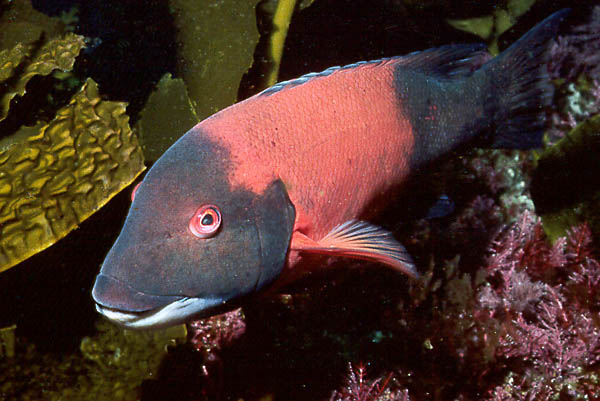
California Sheephead, 3 ft. long. Image from funscubadiver.com

However, there is a problem with taking only the bigger sheephead--only the bigger ones eat sea urchins. This may seem trivial, but sea urchins eat LOTS of kelp, and if there are too many urchins, they may eat too much kelp, which is a really important part of the ecosystem. The ecosystem is called a kelp forest for a reason! The kelp are the biggest part of the ecosystem, like trees. Take out the kelp and you take out a lot of places where other animals and plants live. I proposed to measure what happens when you take away big sheephead: do the urchins destroy the forest? 


Purple sea urchins. Photo by Richard Hermann.

Click here to see a video of a sheephead eating a sea urchin
Joseph See, who posted this video, has some great camera skills.

If you are thinking critically about all this, you might be wondering how I am going to take away the big fish. Then you would probably realize that sounds like a terrible idea because it involves killing lots of fish and potentially destroying the kelp forest. I don't have to do that, which is the great part about my proposal. In certain areas, people have already fished out the largest sheephead. All I need to do is see what the urchins and kelp are like in those areas. 

So there's a super simple description project idea in more than a paragraph, but still less than two pages! I'm not sure I will actually carry out this project for the next five years, but I sure wouldn't mind it. I like the varied research and field techniques involved, and how it combines society a bit. Mostly, I like it because it's a field manipulation on a huge spatial scale (the fish live from central CA to the southern tip of Baja California Sur, Mexico), and it awesomely explores how evolution can change ecosystems without us having to know if the fish are actually evolving. 

Now that that proposal is done, it's back to the drawing board because I want to explore other options for PhD projects. But I've learned not to be intimidated by this task, because in graduate school, impossibility is the mother of great achievement! I'm excited for what impossibilities lay ahead.

~~~~~~~~~~~~~~~~~~~~~************************~~~~~~~~~~~~~~~~~~~~~


As a fun exercise, I am going to track the evolution of the title of my proposal:

My own original idea: Can Fisheries-induced Evolution of California Sheephead Alter Ecosystems?
After advisor read it: Impact of contemporary trait change on trophic cascade strength in a large-scale marine ecosystem
Revision: Impact of large-scale contemporary trait change on trophic cascade strength in a marine ecosystem
Revision: Impact of contemporary trait change on trophic cascasde strength in a large-scale marine ecosystem*
Final title: Impact of contemporary trait change on trophic cascades in a large-scale marine ecosystem

*This one is my favorite, but it was too long for the final proposal.