“Thus organisms and environments are both causes and effects

in a coevolutionary process.”

—Richard C. Lewontin in The Triple Helix: Gene, Organism, and Environment.

Friday, April 25, 2014

Plastic fast--the last few weeks

Happy Easter!
That means my new plastic fast is over. Here are my results and reflections.


Though I haven't posted about it every week, I've certainly been trying to avoid plastic the whole time. I got to the point where there are things I need that I was just waiting to buy until the plastic fast was over. Overall, I wasn't able to totally avoid plastic, but I got better as the fast went on.

  • Things I needed that normally come with new plastic: SCUBA gear, ground flaxseed, cheap coconut oil
  • Things I bought that have new plastic (if any; hopefully this will be none): Stickers on fruit, an underwater compass, half of a diving manual (I split the cost with a friend), a small bag of crystallized ginger (I couldn't resist), a racing number to pin to my shirt.
  • Things I bought in plastic-free form: another strainer and a whisk.
  • Things I did to avoid buying new plastic: I refilled old flour containers, I didn't buy prepackaged food, and I've still been making my own bread like crazy.
  • Things with new plastic that were given to me: a half marathon finisher shirt (well, I guess I paid for it when I registered).
  • Plastic things I politely rejected: none.
  • People who learned about my plastic fast (optional): maybe people who read my blog.
  • What was the hardest part of my fast this week?: buying SCUBA gear. Does any of it come plastic-free? 
  • What was the easiest part of my fast this week?: buying fresh food. 
  • What can I not find a non-plastic alternative for, and can I give up this item entirely?: SCUBA gear, cheap coconut oil. I cannot give up SCUBA gear if I want to keep diving, but I can give up cheap coconut oil and buy more expensive oil in a glass jar.

Here's all the plastic trash (and a bit of non-plastic trash) I used during the fast. I didn't want to dump it out so you can see each item, but at least you can get an idea of volume. It's a paper-grocery-bag full. On top are some old plastic produce bags I had from before the fast, and they make up for the things I forgot to keep.

I learned from this fast that single-use plastics are the easier to avoid, while durable plastic items are sometimes impossible to avoid (for example, when buying SCUBA gear). Since the everyone else thinks plastic is a safe and useful material, it is extremely difficult to avoid it entirely. The most striking observation I made about plastic is how much food comes in really cheap plastic. This is why I lived off the fresh produce and bulk sections of New Leaf.  Unfortunately, all the bulk foods are stored in plastic bins. 

Another striking observation I made was how useful plastic is when backpacking. Storing food in plastic bags one of the best ways to pack food for backpacking trips because plastic bags are super lightweight and collapse-able. It was really hard to plan for my trip without plastic.

Now that the official fast is over, I plan to continue avoiding single-use plastic, but I'm not going to try quite as hard to avoid those durable plastic things I need (like SCUBA gear). In fact, I will probably buy my usual 54 oz. plastic jar of coconut oil as soon as I get paid next month. This is because it's 50% cheaper than what I can get in glass, and I struggle with money for food (probably largely due to my dietary choices). But once I'm being paid like a middle-class American and 51% of my income doesn't go toward paying rent, I will buy only plastic-free coconut oil.

I hope you are inspired to think about your use of plastic! To conclude, here's a picture of what I might study instead of California sheephead. I'll post about how my project is changing later.

Owl limpet Lottia gigantea. Photo by me this year.


Monday, April 7, 2014

Toxicity of all plastic

I stumbled upon this while looking for examples for a class assignment. This table is a good reminder of why I am giving up new plastic. These effects were all familiar to me, but it's good to see them again to keep me really motivated to continue avoiding plastic.

Why do we believe that plastic is safe?


Table from http://bml.ucdavis.edu/wp-content/pdf/cameos/CAMEOS_FormingAnswerableScientificQuestionswnotes.pdf


Friday, April 4, 2014

Plastic fast weeks 2--4

It's been a crazy three weeks, and a lot happened that required me to buy some new plastic. See below.

  • Things I needed that normally come with new plastic: Most of the things below.
  • Things I bought that have new plastic (if any; hopefully this will be none): Fuel for a backpacking stove, the label on some iodine tablets, a waterproof map, the lids to glass food containers, part of a paper bag of pasta (why do they have to put a little plastic window in it?), stickers on stainless steel kitchen utensils, Italian sausage (for my boyfriend), a waterproof bird ID field guide, food-to-go containers with plastic silverware (how horrible!), fruit and vegetable stickers, tags on clothing, the pot that came with a tomato plant.
  • Things I bought in plastic-free form: a strainer, food storage containers, plant pots.
  • Things I did to avoid buying new plastic: I refilled a glass peanut butter jar and put produce directly into my backpack. I buy bulk soap. I bought a used bread machine so I never have to buy bread in plastic bags again. I have also been working on growing my own food plants, and started a compost pile so I won't have to buy as much potting soil for my new garden, although it will be several months or years until I get soil from my compost. 
  • Things with new plastic that were given to me: The lid to a jar of homemade maple syrup, a notebook with a plastic snap, a magnet with a plastic picture of a sea otter.
  • Plastic things I politely rejected: The plastic bag some homemade granola came in, but that's about it. I wasn't about to reject the maple syrup my friend from upstate New York spent weeks making, tapping maple trees and boiling the sap, and the notebook and magnet were a gift for graduating my volunteer course, which inspired this plastic fast. I really have a hard time rejecting gifts.
  • People who learned about my plastic fast (optional): my visiting friends, my lab group, and visitors to my lab group.
  • What was the hardest part of my fast this week?: buying food for my visitors and supplies for backpacking. Also paying so much for soap is annoying, even though it smells divine. It's $22.24 per pound! I should look for cheaper bulk soap.
  • What was the easiest part of my fast this week?: buying fresh food. 
  • What can I not find a non-plastic alternative for, and can I give up this item entirely?: I have never seen a bread machine without a plastic exterior, but I haven't looked. Even if I found one, I wouldn't be able to afford it. Also, all salad spinners have plastic.

Wednesday, April 2, 2014

Fellowship application results

Recent news in my research life: I heard back from two fellowships I applied for! I got really good reviews, but I was awarded neither. These were the Nancy Foster Scholarship and the National Science Foundation Graduate Student Research Fellowship. I'm still waiting to hear back from one more fellowship I applied for, and you can count on me posting about it when I know. Peace!

Saturday, March 8, 2014

Plastic fast: Week 1 Summary

Plastic fast update! I will work on making these more visually appealing. Here's an unrelated picture for now!

Orcas! Sept. 2013

  • Things I needed that normally come with new plastic: nothing
  • Things I bought that have new plastic (if any; hopefully this will be none): fruit with stickers. This seems to be pretty unavoidable unless I take off all the stickers at the store, but that's not saving any plastic.
  • Things I bought in plastic-free form: salad tossers, spatula, colander, camping plate
  • Things I did to avoid buying new plastic: I bought material at Goodwill to make produce bags, so I don't have to use those plastic bags to buy bulk items!
  • Things with new plastic that were given to me: sandwich, retractable clothes line
  • Plastic things I politely rejected: I'm going to reject the clothes line
  • People who learned about my plastic fast (optional): my boyfriend
  • What was the hardest part of my fast this week?: accepting the retractable clothes line knowing that it was wrapped in and made of plastic, then realizing I'm going to have to politely reject it
  • What was the easiest part of my fast this week?: buying food
  • What can I not find a non-plastic alternative for, and can I give up this item entirely?: food processor. Um, I'll keep looking, but I would eat significantly less healthy food if I didn't have a food processor. 

Tuesday, March 4, 2014

Plastic Fast

The best way to appreciate something is to let it go. Don't it always seem to go that we don't know what we've got 'til it's gone?*


Image from world.edu


Ash Wednesday, March 5th this year, marks the beginning of the Catholic season of Lent. During Lent, we remember that life is challenging and people suffer. We also remember that our human sinfulness often keeps us from happiness and distances us from God. Catholics often give up something during Lent to remind them not to get too comfortable in their lifestyles, and to break habits that cause us and others to suffer.

People usually give up things that are personally physically or emotionally unhealthy, like smoking, junk food, or TV. In the past, I've given up chocolate (several times), complaining, and cracking my knuckles. I've also done extra things like devoting more time to prayer and reading scripture. One year I wrote a letter of appreciation to a different person every day of Lent. At the end of the six weeks I had over forty letters and I mailed them all out. I got a lot of wonderful response letters that I still have in my room.

I think what you give up for Lent is even more meaningful if it benefits others. That brings me to this year:

I will give up plastic.

There are lots of reasons to avoid plastic, and the most important for me are that it's harmful for human health and land, sea, and air. No matter how safe it seems, plastic is full of really unhealthy compounds that disrupt normal biological functions. Plus, plastic lasts forever. So as we keep making it, the Earth is becoming fuller and fuller of plastic. I repeat: each day, the Earth is made up of more plastic. That's not okay with me. By giving up plastic, I am not contributing to this linear process and helping keep the Earth a safe place for all Life. I believe that Life is an irreplaceable gift from God, and my love of God and all creation, including you, my reader, compels me to take care of it not for my sake or God's sake alone, but also for your sake, Mosquito's sake, Poison ivy's sake, diatoms' sakes, and the sake of everything that ever has or ever will incorporates into itself that molecule of carbon dioxide you just exhaled.

I have to make rules for my plastic fast so I can reach my goals:
1. I will not buy plastic. This includes packaging.
2. I will not use anything newly purchased that is made of plastic. This includes newly purchased food items that came in plastic wrapping.
3. I will not accept plastic items given to me.
4. If I do somehow end up getting plastic, I will keep it for the duration of the fast and take a picture of it on Easter.
5. I can use long-lasting plastic items I already have (i.e. my computer and my refrigerator), but if I find an affordable non-plastic alternative, I will buy and use that and discard of the plastic item.
6. I will write about my experience in this blog. That includes updates to the rules.
7. If anyone buys a non-plastic alternative item and tell me how much the plastic version cost, I will donate that much in my rice bowl.
8. I will structure my posts in the following way:
  • Week number:
  • Things I needed that normally come with new plastic:
  • Things I bought that have new plastic (if any; hopefully this will be none):
  • Things I bought in plastic-free form:
  • Things I did to avoid buying new plastic:
  • Things with new plastic that were given to me:
  • Plastic things I politely rejected:
  • People who learned about my plastic fast (optional): so far, most of my facebook friends.
  • What was the hardest part of my fast this week?:
  • What was the easiest part of my fast this week?:
  • What can I not find a non-plastic alternative for, and can I give up this item entirely?:
I am excited to see what challenges I encounter. I know plastic is ubiquitous in my life. Already I am noticing I am running out of spices that I bought in plastic containers, and I'm wondering if I will have to eat bland food for the next six weeks.

I appreciate your support and comments. Please send me your ideas for plastic-free alternatives, and I challenge you to spend just one day not buying or using anything plastic!

Peace and Love!

Image from fineartamerica.com

*I realize now that two-liner intro isn't totally applicable to the rest of this post. It implies that I'm going to appreciate plastic more once I've given it up, but there isn't much if anything about plastic to appreciate. I'll leave the intro there anyway because it's sorta catchy and I don't want to write another one. :D


Sunday, February 16, 2014

Año Nuevo State Park

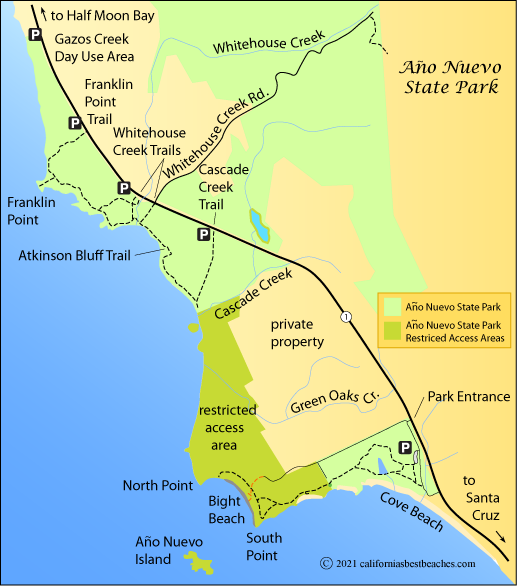
As part of my Seymour Center docent training, I went with the other volunteers to Año Nuevo State Park to experience the rookery of elephant seals.

Map of Año Nuevo from californiasbestbeaches.com

A sign near the visitor's center.


View from a trail.

Año Nuevo State Park is close to Santa Cruz, only about 30 miles north on Hwy 1. Normally, visitors must schedule a guided tour of the rookery if they want to see the seals, because the seals don't care much about visitor safety. They are on the beach once a year to give birth and breed from about December to March (excluding March). During this time, they don't eat or drink, and the males try to gain control of a harem of females in which to obtain mates. This system is actually beneficial for the females, because the dominant male defends her from other males that may harass her.

My favorite facts I learned while at the park were about weight: when mothers feed their pups milk for a few weeks, the moms lose about 200 lbs and the pups gain about 200 lbs! Then the moms leave for the rest of the year to eat back their weight, and the pups stay on the beach for two months while their bodies process all the fat they just gained until they are ready to swim.


We learned a lot about the research being done through UCSC under scientist Dr. Colleen Reichmuth and colleagues. They are trying to understand how the seals communicate vocally, and were on the beach with us recording seal sounds. I can't share the pictures I took of the seals unless it is education-related, so if you learned something from the above paragraphs, email me and I can send you a cool picture or two that you should not share publicly.


*Update: I have since helped Dr. Dan Costa's lab members weigh the weaned pups on the beach. Their research is focused on the life history and feeding ecology of the seals. There were hundreds of them at the beach, looking like sacs of blubber and making cute, guttural screaming noises. Some of them were farther up in the shrubs chewing on leaves. When we would walk by to check their flippers, they would throw their heads back to let out a baby scream and reveal bright green foliage inside their hot pink-colored mouths. We weighed, tagged, and measured them from 7 to 10 am.